
SEO in the Age of Artificial Intelligence: How Google Search Is Changing and What Businesses Can Expect by 2030
Search engine optimization (SEO) is undergoing one of the most significant transformations in the history of the internet. Advances in artificial intelligence, the emergence of generative search systems, and changing user behavior are gradually reshaping how people find information.
In the past, SEO was largely associated with achieving high rankings on Google and driving visitors to a website. Today, a company’s overall digital visibility is becoming increasingly important—not only across traditional search engines, but also in intelligent services such as ChatGPT, Google AI Overviews, and other AI platforms.
Does this mean traditional SEO is becoming less relevant? Or, on the contrary, is high-quality search optimization becoming an even more important foundation for a business’s digital presence?
To answer these questions, we need to examine the evolution of Google Search, trends in search traffic, the impact of artificial intelligence, and the changing strategies of online marketing.
1. The Evolution of Google Search: From One Billion to Five Trillion Queries
Since Google was founded in 1998, search engines have become one of the most important ways people access information and discover products and services.
The growth in the volume of search queries illustrates the scale of this development.
| Period | Estimated annual search queries |
|---|---|
| 1999 | Approximately 1 billion |
| 2000 | Approximately 14 billion |
| 2001–2003 | Tens of billions; more than 55 billion by some estimates |
| 2004–2008 | Tens to hundreds of billions |
| 2012 | Approximately 1.2 trillion |
| 2025–2026 | More than 5 trillion |
Historical figures are approximate and based on different methodologies. Google officially published the latest benchmark in May 2025.
According to Google, the number of searches exceeds five trillion per year. That translates to more than 13.7 billion queries per day and over 158,000 per second.
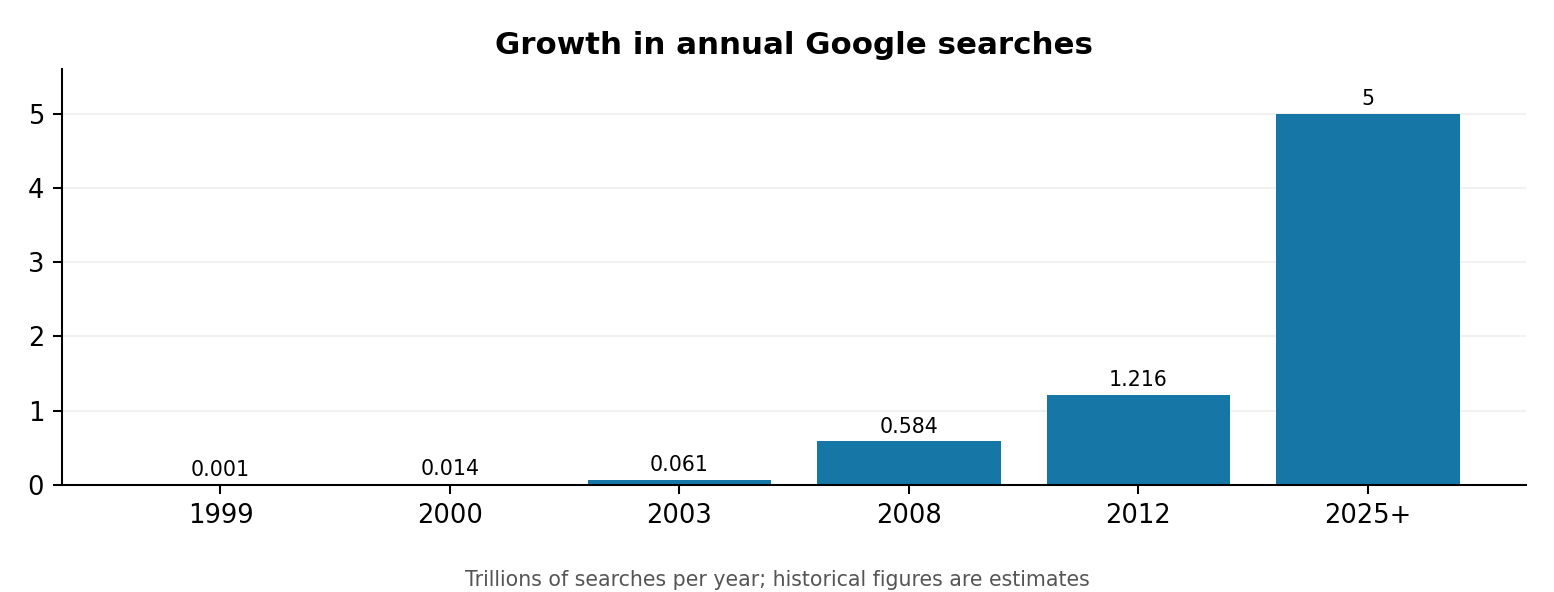
Growth in annual Google searches
The primary growth drivers have been the expansion of internet access, mobile devices, e-commerce, and the volume of digital content.
A fundamentally new trend is now emerging: the number of search queries keeps increasing, but this no longer guarantees proportional growth in website visits.
Users increasingly find the information they need directly in search results or through intelligent services without visiting external websites.
This is changing the traditional economics of search traffic and prompting businesses to reconsider how they measure SEO performance.
2. Google’s Market Share and the Growth of Alternative Search Channels
Google remains the world’s dominant search engine. Nevertheless, its market share has been gradually declining.
In 2023, Google accounted for approximately 93% of the global traditional search engine market. According to Statcounter, the figure stood at 89.94% in September 2026.
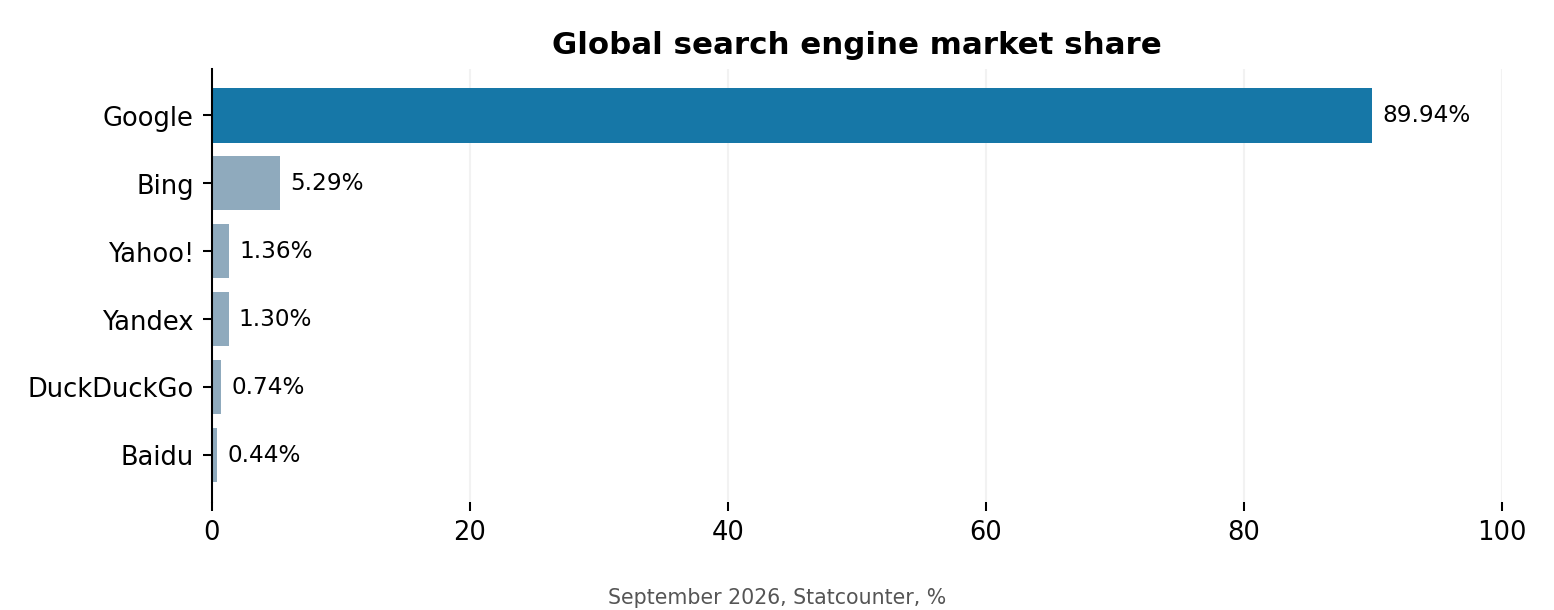
Global search engine market share
Although the decline is relatively modest, the trend deserves attention.
Competition is emerging on several fronts.
Traditional search engines. Microsoft Bing and other competitors are refining their algorithms, integrating artificial intelligence, and introducing new ways to search for information.
Generative AI platforms. ChatGPT and other intelligent assistants let users obtain structured answers, analyze information, compare products, and make decisions through conversation.
Specialized platforms. YouTube, social networks, marketplaces, and mapping services are increasingly being used as search tools in their own right.
It is important to recognize that the popularity of AI services is not directly reflected in statistics measuring the market share of traditional search engines. Google’s declining share therefore cannot be attributed solely to the growth of ChatGPT.
Nevertheless, the broader trend is clear: information discovery is becoming multichannel.
For businesses, this means that relying exclusively on a single search engine is gradually becoming a strategic limitation.
Companies need to be visible wherever potential customers look for information, compare offerings, and make decisions.
3. Mobile Search and Changing User Behavior
The widespread adoption of smartphones has significantly shaped the evolution of SEO.
In recent years, mobile devices have generated approximately 60–65% of global web traffic, although exact figures vary by country, industry, and measurement methodology.
Mobile users expect fast, accurate, and convenient answers.
Whereas someone might previously have browsed several pages of search results, opened numerous websites, and compared information independently, today they are increasingly likely to expect a ready-made solution.
For example, instead of entering the short query “dental implants Riga,” a prospective dental clinic patient might ask:
“What types of dental implants are available, how do they differ, and how much does implant placement cost in Riga?”
Such a question calls for a comprehensive answer explaining the technology, comparing manufacturers, providing indicative prices, and offering guidance on choosing an option.
Scenarios like this are driving the development of intelligent search.
For SEO, this creates a need to understand the target audience’s needs in greater depth.
Simply adding selected keywords to a page is no longer enough. Content should explore the topic, address related questions, and help visitors make informed decisions.
This approach existed long before ChatGPT, but advances in artificial intelligence have made it significantly more relevant.
4. Zero-Click Search: Why Websites May Receive Fewer Visits
One of the most important changes in search marketing is the growth of zero-click search: search sessions that end without a click on a result.
A user gets an answer directly on Google, continues searching, or ends the interaction without visiting an external website.
Previously, these scenarios were associated mainly with simple queries about weather, exchange rates, calculations, or brief reference facts.
Artificial intelligence now enables search engines to answer much more complex questions.
A SparkToro study based on Similarweb data found that 68.01% of Google search sessions in the United States between January and April 2026 ended without a click. The corresponding figure in the 2024 study was 60.45%.
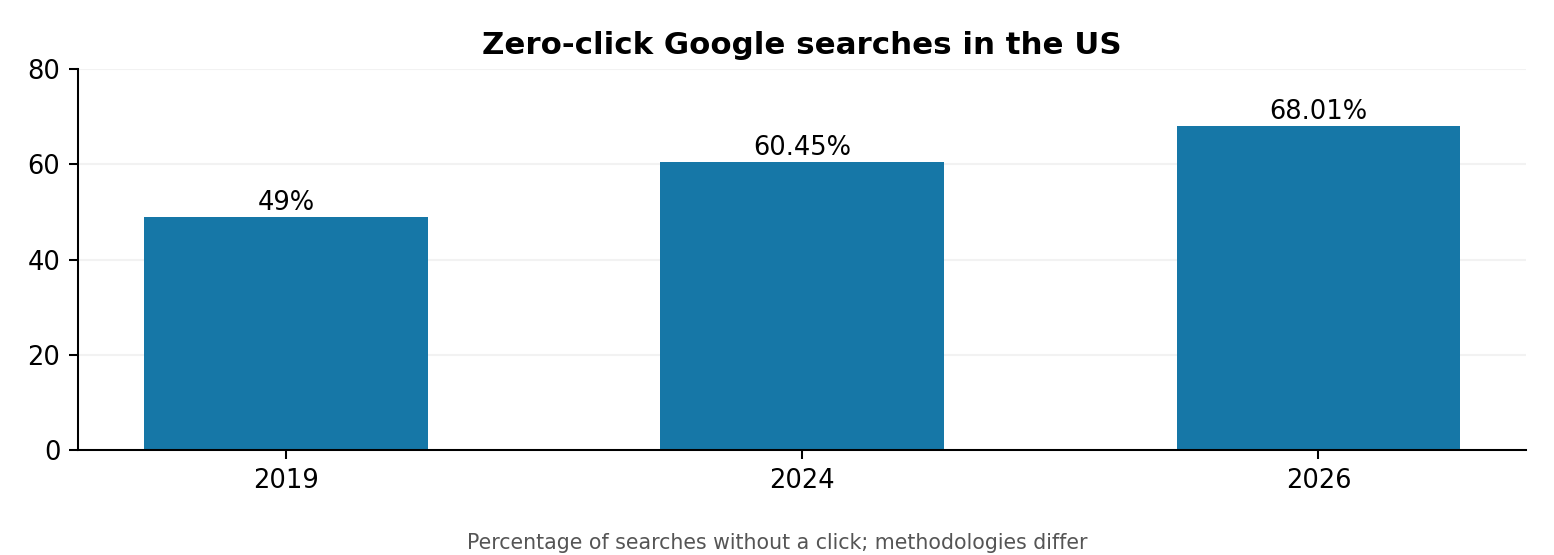
Zero-click Google searches in the US
Differences in research methodology should be taken into account, but the findings illustrate an important trend: a growing share of search activity stays within search platform interfaces.
Google AI Overviews—the generative summaries that bring together information from multiple sources directly in search results—have an additional impact.
This creates a new situation.
A website may offer high-quality content, rank well, and be used as an information source, yet still receive no click from the user.
This may be particularly noticeable for informational queries.
For businesses, however, fewer clicks do not necessarily mean weaker commercial performance. A user may discover a company through an AI-generated answer, remember its name, and contact it directly later.
Consequently, SEO performance assessment increasingly needs to go beyond conventional traffic statistics.
5. SEO, AEO, and GEO: A New Strategy or an Evolution of Existing Principles?
As artificial intelligence becomes more widespread, the terms AEO and GEO are appearing more frequently in professional discussions.
SEO (Search Engine Optimization) refers to optimizing websites to improve their visibility in search engines.
AEO (Answer Engine Optimization) involves optimizing information for systems that provide direct answers to user questions.
GEO (Generative Engine Optimization) refers to approaches designed to increase how prominently information about a company, its products, and its services is represented in generative AI responses.
Despite the new terminology, the fundamental principles of effective search optimization largely remain intact.
Google’s official guidance reinforces this point. The company emphasizes that established SEO practices—including useful content, technical accessibility, clear structure, and value for users—remain relevant for visibility in AI Overviews and AI Mode.
In other words, the arrival of artificial intelligence does not remove the need to build good websites. On the contrary, it makes systematic improvements in website quality even more important.
The DEVNRISE Experience: Comprehensive SEO as a Foundation for AI Search Visibility
At DEVNRISE, SEO has always been approached as a comprehensive effort to strengthen a business’s digital presence, rather than merely boosting rankings for individual keywords.
When developing SEO strategies, the focus has been on technical performance, website structure, information quality, and, above all, the needs of each client’s target audience.
A central part of this work has consistently been the creation of substantial, relevant content: expert articles, service descriptions, answers to frequently asked questions, and resources that help potential customers understand a company’s offering.
The aim has been not only to attract visitors from Google but also to build a valuable information resource that addresses users’ real needs.
The rise of generative AI has revealed an additional advantage of this approach.
According to DEVNRISE’s observations, clients whose websites had benefited from systematic SEO work began noticing that information about their companies and services also appeared in AI chatbot responses and recommendation services.
This is a meaningful practical observation: a strong informational foundation developed for traditional search can also support visibility across emerging intelligent channels.
At the same time, visibility in AI services depends on numerous factors, including the model being used, the wording of the prompt, source accessibility, and how current the information is. Such results should therefore be monitored separately rather than regarded as an automatic guarantee for every website.
Experience with comprehensive SEO suggests that many of the principles now discussed under the labels GEO and AEO are, in fact, extensions of long-established approaches to high-quality digital marketing.
6. How Businesses Can Improve Visibility Across Google and AI Services
An effective promotion strategy today needs to address several interconnected areas.
High-Quality Content Built Around the Target Audience
Content should be developed not only for individual search terms but also around users’ real information needs.
For example, a company installing heating systems can publish comparisons of technologies, operating costs, equipment selection advice, and installation guidance.
These publications can attract visitors through Google while also building an information base potentially useful to generative AI systems.
Original research, practical recommendations, firsthand experience, and insights that cannot be obtained by simply paraphrasing other websites are especially valuable.
Technical Optimization and Information Structure
Even excellent content is unlikely to perform as expected if search engines cannot properly discover and process it.
Technical SEO therefore remains fundamental.
Important elements include correct indexing, logical site architecture, internal linking, mobile usability, loading speed, and structured data.
Information about products, services, prices, and the business itself should be consistent, up to date, and accessible to automated systems.
Building Expertise and Brand Reputation
As automatically generated content becomes more widespread, reliable sources of information become more valuable.
Expert publications, practical examples, transparent service information, and a verifiable reputation help build trust among potential customers.
This matters both for traditional search and for establishing a resilient informational presence for a company.
Multichannel Promotion
A modern digital strategy should not be limited to Google.
Depending on the industry, businesses should consider Google Maps, social networks, specialist platforms, video content, marketplaces, and generative AI services.
However, an effective multichannel approach does not require a presence on every platform. The priority is to select the channels actually used by the business’s target audience.
Analytics and Continuous Strategy Development
Alongside search rankings and organic traffic, companies should examine enquiries, commercial conversions, brand awareness, and visibility in AI responses.
The latter can be assessed by regularly testing common target-audience queries, recording mentions of the company, and reviewing the sources cited by intelligent services.
These measurements are not yet as standardized as traditional web analytics, but they can reveal new opportunities for growth.
This combination of disciplines is at the heart of DEVNRISE’s comprehensive approach: the company develops strategies designed to improve clients’ website visibility in traditional search while expanding their presence across emerging digital information channels.
7. The Future of SEO Through 2030: Key Predictions
Advances in artificial intelligence provide a basis for several forecasts about the future of search marketing.
Prediction one: Google will remain a leading search platform, but search itself will become more intelligent.
Traditional results, generative answers, personalized recommendations, and conversational interfaces are likely to become increasingly integrated.
Prediction two: informational traffic will face continued pressure.
Websites offering only generic reference content may gradually lose some clicks. Original expert insights, commercial offerings, and specialist services, however, will retain distinct value.
Prediction three: content quality will matter more than content volume.
Mass-producing similar SEO articles will increasingly fail to provide a competitive advantage. Accuracy, relevance, practical usefulness, and originality will take center stage.
Prediction four: SEO, GEO, and AEO will gradually converge.
Rather than treating each platform separately, businesses will develop a unified digital presence that makes information accessible across search engines and intelligent interfaces.
Prediction five: marketing effectiveness will increasingly be measured by business outcomes.
Traffic will remain an important metric, but greater emphasis will fall on audience quality, enquiries, sales, and long-term brand recognition.
These predictions do not rule out new technologies or changes to search algorithms. Nevertheless, they point to a lasting trend: SEO is becoming more comprehensive and more closely connected to the overall online marketing strategy.
Conclusion
The search industry has entered a new phase of development.
Google continues to process trillions of queries each year, but more and more users obtain answers directly from search engines and generative AI services.
As a result, conventional SEO metrics—rankings and clicks—no longer always provide a complete picture of a company’s digital visibility.
Yet these changes do not signal the disappearance of search engine optimization.
On the contrary, comprehensive SEO built on high-quality content, target-audience understanding, technical optimization, and business credibility is becoming even more relevant.
DEVNRISE’s practical experience suggests that systematic investment in the informational quality of websites can create value not only in traditional Google Search but also across new AI channels. Learn more: https://devnrise.lv/ru/
The strategic challenge for modern businesses is therefore not to rebuild their marketing every time a new technology emerges, but to create a resilient digital infrastructure that remains effective as the ways people find information change.
The future of SEO is about more than competing for Google rankings. It is about managing a business’s visibility across a digital environment where traditional search engines, artificial intelligence, and other information platforms are becoming parts of a single ecosystem.
Sources
- Google (2025). More opportunities for your business on Google Search. https://blog.google/products/ads-commerce/google-search-ai-brand-discovery/
- Statcounter (2026). Worldwide Search Engine Market Share. https://gs.statcounter.com/search-engine-market-share/worldwide
- SparkToro (2026). In 2026, Less than One Third of Google Searches Still Send a Click. https://sparktoro.com/blog/in-2026-less-than-one-third-of-google-searches-still-send-a-click/
- Google Search Central (2026). AI Features and Your Website. https://developers.google.com/search/docs/appearance/ai-features
- Google Search Central (2026). Optimizing Your Website for Generative AI Features on Google Search. https://developers.google.com/search/docs/fundamentals/ai-optimization-guide
- Google Trends. https://trends.google.com/trends/
Author: Igors Babics
